Skip to content
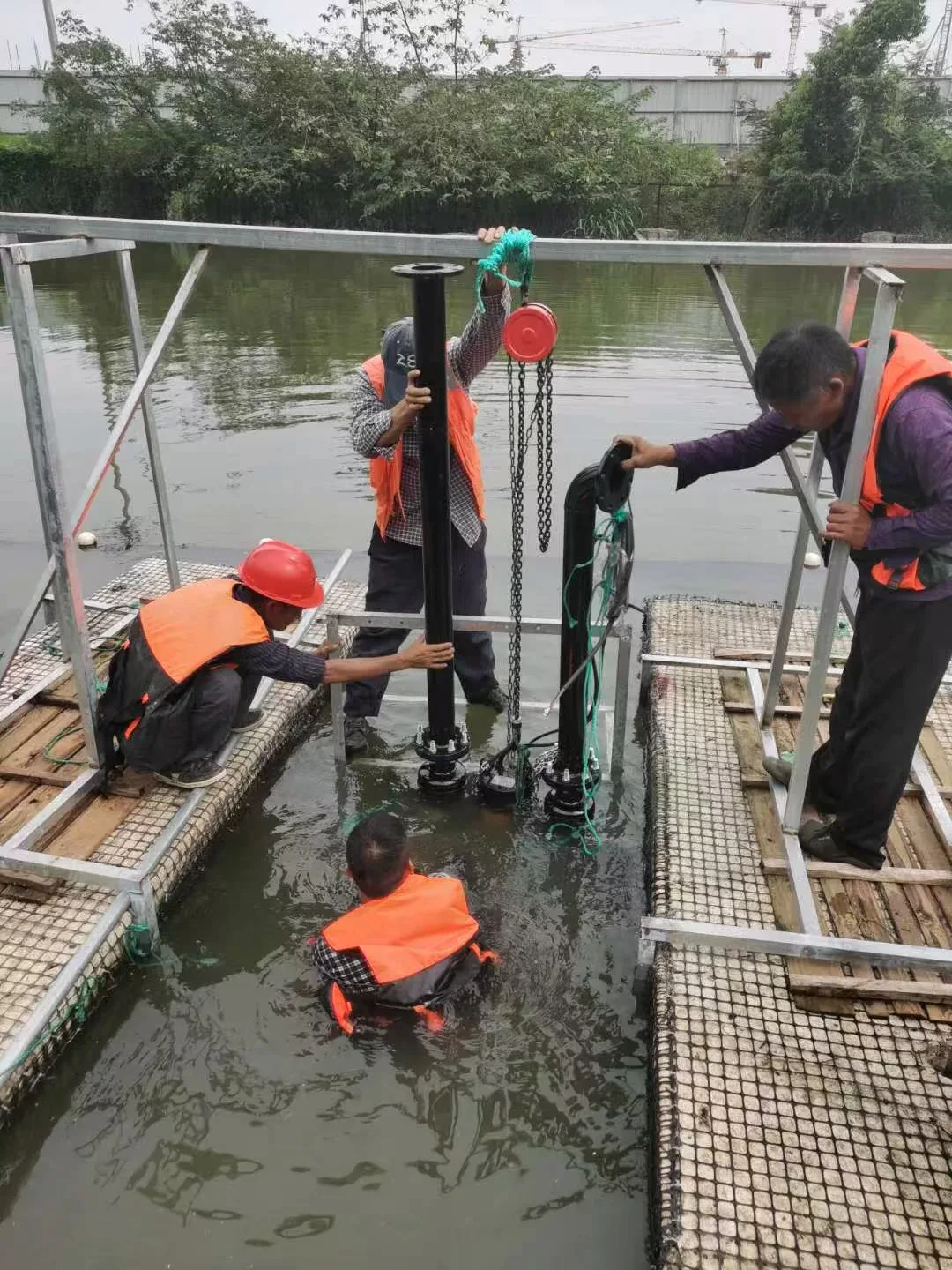
In the fields of sewage treatment, aquaculture and water ecological restoration, submerged fans are becoming the "invisible power engine" to solve the problem of underwater aeration and oxygenation with their design and high efficiency. This kind of equipment, which immerses the motor and impeller in water, realizes efficient gas transportation in the underwater environment through a precise airflow generation mechanism, providing key support for the stable operation of the aquatic ecosystem.
I. Technical principle: the game between water resistance and airflow
The core of the submerged fan lies in the balanced design of "water resistance adaptation" and "airflow boosting". The motor is driven by DC or AC power supply, and converts electrical energy into mechanical energy through the principle of electromagnetic induction to drive the impeller to rotate. The impeller design needs to take into account both water flow resistance and airflow pressure, and the number, shape and inclination angle of its blades are optimized by fluid dynamics. When the impeller rotates, the water flow is sucked into the center of the impeller and discharged at an accelerated rate under the action of centrifugal force to form a high-pressure airflow. This design needs to overcome the density and viscosity resistance of water, so the impeller material is usually made of high-strength stainless steel or engineering plastics, and the surface is treated with a special coating to reduce the friction coefficient.
II.Types and selection: Diversity of scenario adaptation
According to application requirements, submerged fans can be divided into five types:
Roots blower: suitable for large sewage treatment plants, providing continuous and stable large-flow gas output, with a wind volume range of 0.83-16.25m3/min and a pressure range of 1000-6000mmaq;
Centrifugal fan: suitable for scenarios requiring higher wind pressure, such as deep water aeration tanks;
Turbine fan: maintains stable operation within a wide flow range, often used for landscape water oxygenation;
Spiral fan: suitable for medium wind volume and wind pressure requirements, such as aquaculture ponds;
Piston fan: mostly used in small or medium-sized sewage treatment facilities, achieving gas compression through reciprocating motion.
Key considerations when selecting:
Air volume and pressure: calculated based on water depth, dissolved oxygen demand and aeration device resistance;
Water quality conditions: 316L stainless steel should be used for corrosive water, and pre-filters should be installed in high-impurity environments;
Energy efficiency ratio: high-efficiency models can reduce energy loss by more than 5%;
Maintenance convenience: modular design facilitates underwater maintenance, such as the TSW type fan of Chun Ding, Taiwan, China, which uses O-ring sealing technology and does not require traditional belt adjustment.
III. Application scenarios: from water treatment to ecological restoration
Wastewater treatment: In the sludge aeration process, the submerged Roots blower generates tiny bubbles to allow oxygen to fully contact the sludge and improve the activity of aerobic microorganisms. Its vortex effect can stir the deposited sludge to prevent compaction.
Aquaculture: Provide continuous dissolved oxygen for the aquaculture pond. For example, Shengshi Huixi submerged blower can increase the dissolved oxygen content of the water to more than 8mg/L, promote fish growth and reduce ammonia nitrogen accumulation.
Water ecological restoration: In lake management, by increasing dissolved oxygen, algae reproduction is inhibited and aquatic plant growth is restored. Experimental data show that the transparency of water bodies can be increased by more than 30% after using submerged fans.
Firefighting and diving equipment: Provide airflow support for underwater firefighting systems, or serve as a power source for submersibles. Its low noise characteristics (≤65dB) can reduce interference with aquatic organisms.
Fourth, innovative advantages: breakthrough design for underwater operation
Space optimization: No ground installation space is required, especially suitable for small aquariums or integrated sewage treatment equipment;
Silent operation: The refraction of sound waves by water media reduces noise by 20-30dB;
Anti-corrosion technology: Adopt corrosion-resistant materials such as WCB and 304, with IP65 protection level, to extend equipment life;
Intelligent control: Equipped with sensors and control systems, it can monitor current, voltage, temperature and other parameters in real time, and support remote fault diagnosis.